• Welcome to My Little Tummy Aches, a community free of charge. All health-related content on this website is for informational purposes only and does not create a doctor-patient relationship. Always check with your physician before taking any action regarding your health or the health of your child. Join us, so you too can help other parents. Social Media Buttons

Pediatric GI latest research publications (relevant to parents)

Administrator

Administrator
Staff member
Does constipation go away after stopping gluten in newly diagnosed celiac disease pediatric patients?

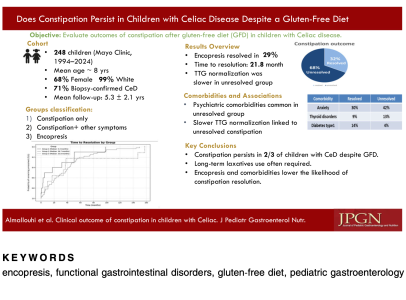
A 2025 study in Journal of Pediatric Gastroenterology & Nutrition followed 248 children with celiac disease who initially presented with constipation.

The findings were striking:
• Only 32% had constipation fully resolve on a gluten-free diet
• 68% required ongoing laxatives, even years later
• Children with encopresis had even lower resolution rates
• Anxiety, depression, and thyroid conditions were more common when constipation persisted

Bottom line: a gluten-free diet alone is often not enough. Constipation in children—especially when chronic—requires long-term, multidisciplinary support, not just dietary changes.

Source: Almallouhi A, Sadek M, Absah I. Clinical outcome of constipation as the presenting symptom in children with celiac disease. J Pediatr Gastroenterol Nutr. 2025. doi:10.1002/jpn3.70316

#PediatricGI #CeliacDisease #ChildhoodConstipation #Encopresis #GutHealthKids #ParentSupport #MyLittleTummyAches #EvidenceBasedParenting
 

Attachments
  • jpgn1.png
    jpgn1.png
    434.3 KB · Views: 1
  • jpgn2.png
    jpgn2.png
    202 KB · Views: 1
Last edited:
Is fatigue in pediatric IBD is only about gut inflammation?

Fatigue often persists even when the disease is “under control.”

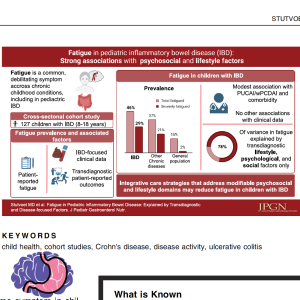
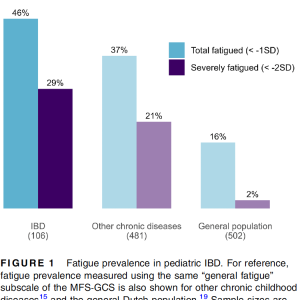
A 2025 study in Journal of Pediatric Gastroenterology & Nutrition found that nearly 1 in 3 children with IBD experience severe fatigue, even during clinical remission .
What actually drives fatigue?
- Poor sleep
- Anxiety and depressive symptoms
- Pain
- School pressure and missed school days
- Reduced physical, emotional, and social functioning

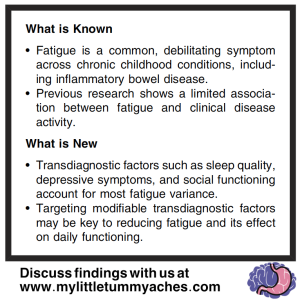
In fact, psychological, lifestyle, and social factors explained 78% of fatigue, while traditional disease markers (labs, inflammation levels) played a much smaller role.

This matters because fatigue affects:
• Daily functioning
• School participation
• Quality of life for the whole family

Citation: Stutvoet MD, Vroegindeweij A, Toonen TZ, et al. Fatigue in pediatric inflammatory bowel disease: explained by transdiagnostic and disease‐focused factors. J Pediatr Gastroenterol Nutr. 2025;1‐10. doi:10.1002/jpn3.70317

#PediatricIBD #ChronicIllnessInKids #GutHealth #IBDFatigue #ParentSupport #WholeChildCare #MyLittleTummyAches
 

Attachments

  • fatigue1.png
    fatigue1.png
    383.4 KB · Views: 1
  • fatigue2.png
    fatigue2.png
    160.3 KB · Views: 1
  • fatigue3.png
    fatigue3.png
    246.6 KB · Views: 2
Improving IBD or IBS symptoms with cognitive behavioral therapy (CBT) and biofeedback.

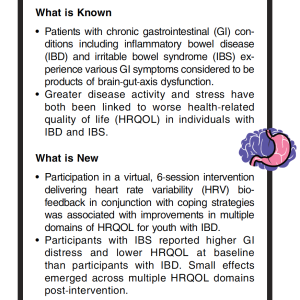
A new 2026 randomized controlled trial in The Journal of Pediatric Gastroenterology & Nutrition found that adolescents with chronic GI conditions—especially IBD—experience meaningful improvements in physical, emotional, school, and psychosocial functioning when care includes coping skills and stress-regulation support, not just medications.

Researchers studied teens with IBD and IBS who participated in a 6-week virtual program combining cognitive behavioral therapy (CBT) with heart-rate variability biofeedback—a tool that helps regulate the brain-gut stress response.

Key takeaways for families:

• Chronic GI disorders affect how kids feel, learn, and function day to day

• Stress and the brain-gut connection play a major role in symptoms

• Teaching coping skills can significantly improve quality of life—especially for youth with IBD

• GI care works best when it addresses both the body and the nervous system

Citation: Younginer ST, Westbrook A, Buzenski J, et al. Health‐related quality of life in youth with chronic gastrointestinal disease following a biofeedback enhanced cognitive behavioral therapy intervention: a randomized controlled trial. J Pediatr Gastroenterol Nutr. 2026;1‐12. doi:10.1002/jpn3.70333

#PediatricGI #BrainGutAxis #IBD #IBS #ChildHealth #ParentSupport #MyLittleTummyAches #EvidenceBasedCare
 

Attachments

  • cbt3.png
    cbt3.png
    342.8 KB · Views: 0
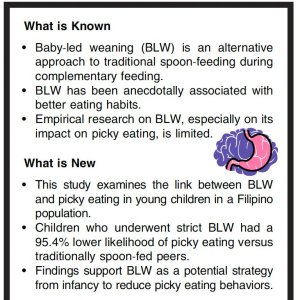
Does baby‐led weaning help against picky eating?

A 2026 study in Journal of Pediatric Gastroenterology & Nutrition found that children who followed strict baby-led weaning had a 95% lower likelihood of picky eating between ages 2–5 compared to children who were traditionally spoon-fed.

Why we want to talk about picky eaters in pediatric GI:

• Picky eating is linked to constipation
• Limited food variety can impact nutrition
• Mealtime stress affects digestion and appetite regulation

Baby-led weaning can help support:
- Self-regulation of hunger and fullness
- Exposure to textures early on
- Positive, pressure-free mealtime

“This study provides evidence that Baby‐Led Weaning is associated with substantially lower picky eating behavior among children aged 2–5 years, a relationship that persisted across multiple sensitivity analyses. These findings support BLW as a potentially effective approach to fostering positive feeding”

Citation: Layug‐Dionglay FDMG, Navarro JO, Guno MJV, Napalinga KM. The association of baby‐led weaning and picky eating in children aged 2–5 years. J Pediatr Gastroenterol Nutr. 2026;1‐11.doi:10.1002/jpn3.70331
 

Attachments

  • 619445295_122260066364220252_3972828744590515774_n.jpg
    619445295_122260066364220252_3972828744590515774_n.jpg
    109.9 KB · Views: 0
Back
Top